
My approach
Persistent Pain
When pain continues, the answer is not always in the place that hurts.
Living with persistent pain can be frustrating and confusing. Perhaps an injury healed some time ago, yet the pain remains. Perhaps scans have shown little to explain the level of discomfort you experience. Or perhaps you have tried treatments that helped for a while, only for the pain to return.
This does not mean that your pain isn’t real.

Persistent pain is real, but it does not always mean that your body is still being damaged.
When pain continues for longer than expected, the nervous system can become increasingly sensitive. The body’s protective alarm system can remain switched on, responding to things it has learned to perceive as threatening — sometimes long after the original injury has healed.
This is where persistent pain requires a different way of thinking.
01 · Assessment
Understanding what is keeping your pain going
My assessment begins by making sure there isn’t an underlying injury, medical condition or other problem that needs to be addressed or referred on.
Once we have established that, we look beyond the painful area.
I want to understand why your nervous system may have remained sensitive and what might be continuing to signal danger to it.
This means exploring your pain from several different perspectives.
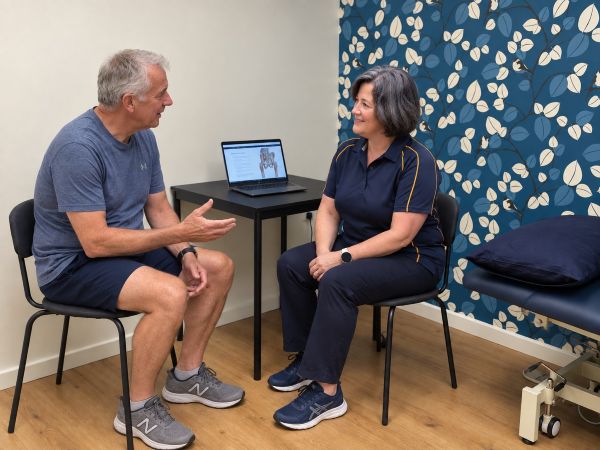
02 · The whole picture
Looking at the whole picture
Pain is multidimensional. It is influenced by much more than what is happening in the tissues.
We explore the biological, psychological and social factors that may be influencing your pain and your nervous system.
Biological
Biological factors might include previous injuries, illness, genetics, physical activity, sleep and other aspects of your health and lifestyle.
Psychological
Psychological factors can include your beliefs about pain, emotions, memories, expectations and the ways you have learned to respond to symptoms.
Social and contextual
Social and contextual factors may include relationships, family, work, culture, faith, your physical environment and the demands placed upon you.
This isn’t about finding something to blame for your pain.
It is about understanding the whole person and the many influences that can affect how sensitive your nervous system has become.
And there is something very encouraging about this.
If there are multiple influences on your pain, there are also multiple opportunities to influence it.
03 · Understanding pain
Why understanding pain matters
When you have lived with pain for a long time, advice such as “try to move more” or “don’t be afraid of the pain” can make very little sense.
Understanding why you hurt can change that.
Learning about pain and neuroplasticity can help you make sense of your symptoms and understand why pain can sometimes persist even when there is no ongoing tissue damage. It can also reduce some of the fear and uncertainty that can surround pain.
When we understand what is happening, pain flare-ups can become less frightening. You can begin to distinguish between pain and danger and develop a different relationship with your symptoms.
Knowledge isn’t the whole answer, but it gives you a framework from which to make meaningful changes.
04 · Working together
Rebuilding trust in your body
Our aim is not simply to find ways of managing your pain from day to day.
Together, we work towards rebuilding your trust in your body and changing the way you understand and respond to your symptoms. This may involve:
Making sense of your pain
Understanding your individual pain experience and the factors that may be contributing to your nervous system’s sensitivity.
Supporting your nervous system
Exploring strategies that help your system move out of a constant state of threat or protection.
This may include learning to recognise and manage your stress responses and finding practices that help your body feel safer and more settled.
Building healthy foundations
Sleep, activity, nutrition, stress, relationships and other aspects of everyday life can all influence how sensitive the nervous system becomes.
We look at realistic changes that support your overall health and resilience — without adding another list of things you should be doing.
Rediscovering movement
When pain has been present for a long time, movement can become something to fear or avoid. But movement is an important part of recovery.
Together, we find ways to move that feel safe and achievable, gradually building your strength, confidence and capacity. The aim is not to force your body through pain, but to help your nervous system learn that movement is not necessarily dangerous.
Movement becomes part of the solution rather than something to fear.
05 · Recovery is possible
Recovery is possible
Persistent pain can change the way you see your body. You may have lost confidence in what it can do or become cautious about movements and activities you once took for granted.
But the nervous system is capable of change.
Just as it can become more sensitive, it can also become less sensitive.
Through understanding, movement, healthy lifestyle changes and reducing the sense of threat within the nervous system, we can help create the conditions for change.
Recovery doesn’t necessarily mean waiting for every trace of pain to disappear before you begin living again.
It can mean learning to move with greater confidence, reducing the fear around symptoms and gradually returning to the people, activities and life that matter to you.


You don’t have to live in fear of your pain.
Understanding your pain is an important first step. Together, we can work towards making sense of your symptoms, rebuilding trust in your body and helping you move forward with greater confidence.